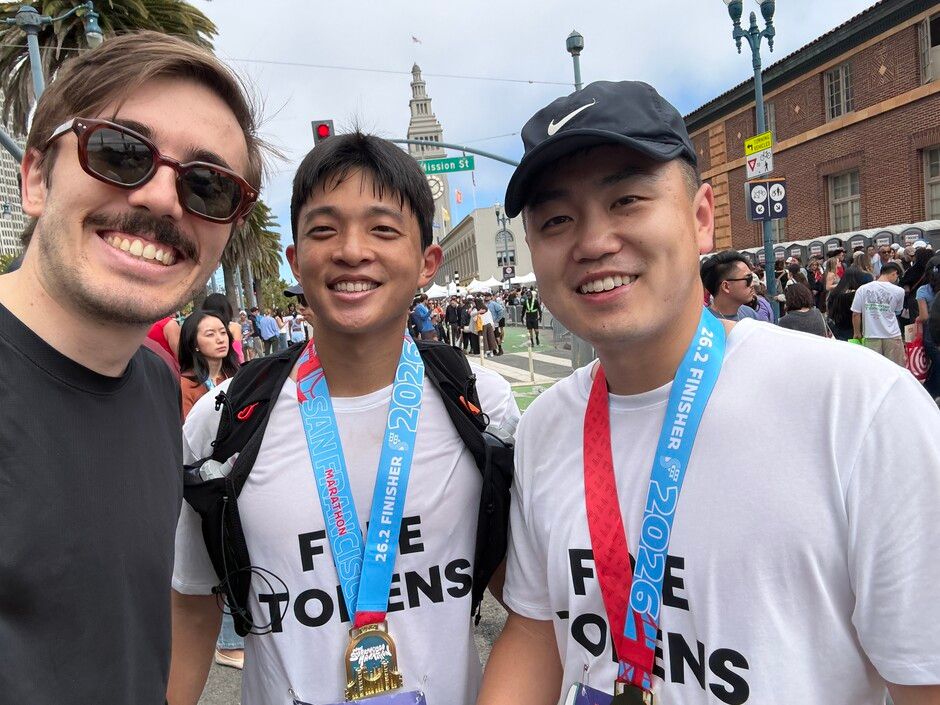
Before Alex Lee joined Magic Patterns (W23), he was running his own company, Iago — one that's still self-running today. But when his former Robinhood colleague Teddy co-founded Magic Patterns, a tool that helps product designers create interactive mockups and prototypes, Alex saw something he couldn't pass up: an AI-first approach to a problem he'd hit himself while building new features at Iago. "It's pretty clear that Figma is going to be replaced and a company like Magic Patterns is here to replace it," he says.
Technically, Alex was employee number two — a sales hire came first — but he was already working part-time before he officially started.
Why Magic Patterns
Alex already knew co-founder Teddy from Robinhood. They'd stayed in touch, texting about startups and sharing philosophies about work and engineering. "I felt like I aligned really well with Teddy and Alex" — the co-founders — "and how they thought, and felt like I'd not only grow but grow with the company if I joined."
The problem space pulled him in, too. Magic Patterns is used by more than 3,000 product teams, and Alex gets a front-row seat to how those teams are reshaping design in an AI world. "Especially as the different product team roles — eng, design, product — start to blend, it's super interesting to see how fast everything's evolved, and stay on top of it."
Owning problems, not just features
"You're not just a code monkey, but you're also a product person," Alex says. "Things move so fast at a small company that you don't just own features, you own problems. And when you find solutions, you're in charge of finding the next set of problems to solve."
That means coding, yes — but also improving the onboarding funnel, talking to customers, and jumping on support. One weekend, Alex noticed users weren't just making designs but building slide decks to present those designs to leadership. So he built out an entirely new file type with full slide deck features over the weekend and shipped it. "A big company wouldn't even let me ship this without talking to the right team who 'owned' this product surface."
He also landed on the front page of Hacker News with a side project done at work: an agent that builds Rollercoaster Tycoon-influenced theme parks from a prompt.
The daily toolkit
Alex dogfoods Magic Patterns itself to design new features. Once something is ready to implement, his workflow looks like this:
- Cursor and Claude Code, always on the latest models
- Cursor connected to Slack — he prompts it directly for small bug fixes and features
- An internal code reviewer agent called Patterson that reviews code before it ships
- Three clones of the same GitHub repo instead of worktrees, so he can work on features in parallel
Transparency as a feature
Alex says the thing that surprised him most about startup life is how transparent it is. "Everyone at Magic Patterns knows the financials, growth rate because the founders trust us, but also because they are building a very open and transparent culture." He actually thinks large companies carry more hidden risk. "You never know when they might lay people off or have a change in direction."
The founders, Teddy and Alex, foster a culture of trust and autonomy. "They're incredibly receptive to feedback and will always take action on it."
Now that the team has grown to ten people, Alex has taken on more interviewing and has become the dedicated forward-deployed engineer for enterprise customers, especially around Magic Patterns' Design Systems vertical — the top-requested enterprise feature.
Who should join
"If you're early in your career, make a polarized bet," Alex says. "You'll work more than a typical 9-5 but you'll be learning a lot more in return." If you want real ownership, the chance to ship a feature over a weekend, and a view overlooking Coit Tower from a new San Francisco office, Magic Patterns is hiring an engineer who wants to build the world's best AI design agents.
Categories
Founding Engineer SeriesWork at a StartupAuthor
Ryan Choi
Ryan works with YC companies to find great engineers — from 2-person startups to larger ones like Airbnb, Stripe and Instacart.
Other Posts
What startup hiring looks like in 2021 — and during a pandemic
Jan 17, 2022
Watch 30 founder pitches from YC's GTM Jobs Expo
Apr 22, 2021
6 founding engineer roles at W22 YC startups
Jul 12, 2022
Want to sign up for weekly updates from YC?Sign up for the newsletter